
Being busy feels productive. A full calendar, constant messages, and a long list of open tasks can create the sense that work is moving. Yet many of the teams I work with are busy in ways that quietly waste time. The difference between being busy and having a broken workflow is the difference between motion and progress. One keeps people occupied. The other produces decisions, ownership, and finished work that does not have to be redone.
I learned this distinction the hard way in product operations and later in consulting. A team can look extremely active while still stuck in the same recurring problems: unclear ownership, repeated questions, meetings that produce no decisions, and tools that require more maintenance than they remove. The calendar stays full. The actual work stays incomplete. That pattern is what a friction audit is designed to surface.
Why Busyness Hides Broken Workflows
Busyness is visible. Broken workflows are often invisible until you look for them on purpose.
A full day of meetings can feel like progress even when no decisions were recorded and no owners were assigned. A long email thread can feel like collaboration even when the same question has been asked three times. A dashboard that everyone is supposed to check can feel like transparency even when no one is sure who is responsible for acting on the numbers.
These patterns create the appearance of activity while the underlying process stays inefficient. People stay busy responding to the symptoms. The root friction remains untouched. Over time the team spends more energy managing the work than doing the work.
I have watched this happen in small teams and in larger ones. The common thread is that the system itself has become the source of delay. Adding more effort inside a broken workflow rarely fixes it. Identifying the friction does.
What a Broken Workflow Actually Looks Like
A broken workflow usually shows up in a few repeatable ways.
Unclear ownership
Work sits because no one is sure who is supposed to move it forward. People wait for someone else to act. Follow-ups multiply. The same item appears in multiple status updates without progress.
Repeated questions
The same information is asked for again and again because it is not captured in a place people trust or can find quickly. Context lives in individual inboxes or chat threads and has to be reconstructed each time.
Meetings that produce no decisions
Calls fill the calendar yet end without clear next steps or named owners. Participants leave with different understandings of what was agreed. The next meeting begins by re-litigating the previous one.
Tool sprawl that creates extra steps
Multiple systems require updates for the same piece of work. People spend time moving information between tools instead of advancing the actual task. The stack becomes part of the workload.
Handoffs that lose context
When work moves from one person to another, key details disappear. The receiving person has to ask clarifying questions or redo earlier steps. Friction compounds at every transition.
These patterns are ordinary. They appear in client work and in household logistics. They are also fixable once they are visible.
A Simple Way to Tell the Difference
When a team feels overloaded, I ask a few direct questions:
Are the same problems appearing every week?
Do people spend more time coordinating the work than doing the work?
Are decisions hard to find after meetings end?
Does information live in too many places?
Would removing one tool or one recurring meeting reduce confusion rather than create it?
If the answers point to recurring process problems, the issue is likely a broken workflow rather than a simple lack of effort or time. Busyness is the symptom. Friction is the cause.
This distinction matters because the solutions are different. Working harder inside a broken process rarely improves results. Changing the process can.
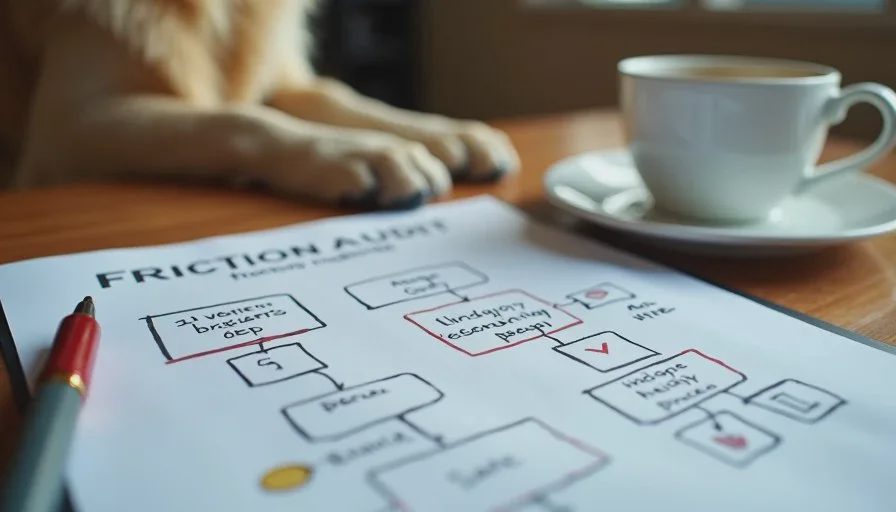
How I Run a Lightweight Friction Audit
I keep the audit short and concrete. The goal is visibility, not a lengthy report.
Step 1: Pick one recurring pain point
Choose a process that already feels heavy—status updates, meeting follow-ups, handoffs between roles, or a tool that requires constant maintenance. Start with something small enough to examine in under an hour.
Step 2: Map the actual path of the work
Write down what currently happens, not what is supposed to happen. Who touches the work? Where does information live? Where do people wait? Where do the same questions keep appearing?
Step 3: Look for the highest-friction points
Identify the places where work slows, ownership becomes unclear, or information has to be reconstructed. These are usually the spots that generate the most busyness with the least progress.
Step 4: Test one small change
Remove a step, clarify one owner, combine two tools, or stop a recurring meeting that no longer produces decisions. Measure whether the change reduces coordination cost without creating new problems.
Step 5: Check it against real conditions
Ask whether the adjusted process still works when someone is out, when priorities shift, or when the day turns into an ordinary Tuesday full of interruptions. A change that only works under ideal conditions is not a real improvement.
This sequence stays light on purpose. Elaborate audits often become another source of work. The useful version produces one or two clear adjustments that people can actually try.
What I Have Seen Work in Practice
In client work the highest-leverage changes are often the simplest. Naming a single owner for a recurring process reduces follow-up messages. Capturing decisions in one consistent place reduces re-litigation. Ending a meeting that no longer produces outcomes frees calendar space without reducing progress.
At home the same logic applies. When the family calendar became a source of repeated questions, we did not add another app. We clarified who updates which type of event and stopped trying to capture every detail in multiple places. The volume of “what time is that again?” messages dropped. The system became quieter.
The common thread is reduction rather than addition. Fewer moving parts usually outperform a more elaborate stack that requires constant attention.

Common Traps to Avoid
A few patterns tend to keep teams stuck in busyness:
Treating every problem as a tool problem. Sometimes the issue is unclear ownership or missing decisions, not the software.
Adding process on top of process. A new checklist or dashboard can increase coordination cost if the underlying handoff remains broken.
Measuring activity instead of outcomes. Full calendars and long message threads can look productive while the actual work stays incomplete.
Ignoring the cost of context switching. Every extra tool or status request extracts attention that could be spent on the work itself.
These traps are common because they feel responsible. They create visible activity. They also keep the underlying friction in place.
When the Audit Is Worth Doing
A friction audit is useful when the same problems keep reappearing, when people report that coordination takes more time than the work itself, or when the team has added tools and meetings without seeing clearer progress. It is less useful as a one-time event. The value comes from treating it as a periodic check rather than a permanent project.
I run a short version with clients when they describe feeling constantly busy yet behind. We look at one process, map the real path of the work, and test one reduction. The goal is not a perfect system. The goal is a process that produces more progress with less coordination overhead.
Will This Still Work on Tuesday?
That remains the test. A workflow that only functions when everyone is present, focused, and uninterrupted is not robust enough for real conditions. The useful changes are the ones that still hold when someone is out, when priorities shift, or when the day fills with ordinary interruptions.
Being busy is easy to achieve. Building a workflow that reduces unnecessary friction takes a clearer look at where the work actually gets stuck. The difference shows up in fewer repeated questions, clearer ownership, and more finished work that does not have to be redone.
Make it useful. Make it human. Make it survive Tuesday.




No comments yet — be the first to share a thought.