
Small teams rarely suffer from a lack of tools. They more often suffer from a lack of shared clarity about how recurring work is supposed to move. Decisions get remade. Ownership stays fuzzy. New people reconstruct context from scattered messages. The same questions reappear in meetings and chat threads. In these conditions a single, well-maintained one-page process document can reduce more friction than adding another platform.
I have watched teams adopt sophisticated systems while still lacking a plain description of their core operating agreements. I have also helped teams create a deliberately modest one-page document that becomes the reference point for how work actually gets done. The difference in coordination cost is usually visible within a few weeks.
I’m Audrey Whitlock. I live in Denver with Jake, Noah, Sophie, and Cooper. My consulting work focuses on reducing operational friction for small teams without unnecessary software. This piece is about the lightest process artifact that consistently earns its place: one page, kept current, and actually used.
Why One Page Is Usually Enough
Long process documentation has a poor survival rate. It is written with good intentions, stored in a wiki or shared drive, and then slowly drifts out of date. People stop trusting it. They stop opening it. The document becomes archaeological evidence of how someone once hoped the work would function.
A one-page limit forces prioritization. Only the agreements that genuinely reduce repeated friction make the cut. Everything else stays informal or is handled case by case. The constraint is a feature. It keeps the document inside the attention budget of people who already have full workloads.
The goal is not comprehensive coverage. The goal is a shared reference for the handful of processes that generate the most confusion when they are unclear.
What Belongs on the Page
The most useful one-page documents I have seen focus on a short list of high-friction topics. Exact contents vary by team, but the categories below cover the majority of recurring pain.
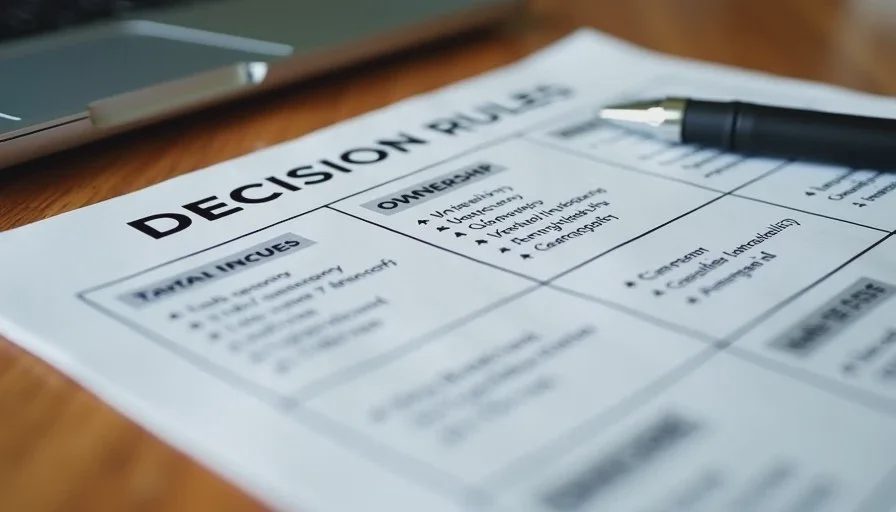
How decisions are recorded and where they live
A clear statement of where final decisions are written, who is responsible for recording them, and how people find them later. This single agreement prevents a surprising amount of re-litigation and search time.
Ownership defaults for recurring work
Which roles or named people own the main categories of ongoing work. When ownership is explicit, fewer tasks sit in collective limbo and fewer status meetings are needed to compensate.
The path for common handoffs
How work moves between people or functions for the team’s most frequent transitions. A few sentences or a simple labeled flow is enough. The point is to reduce the “I thought you had this” moments.
What “done” looks like for key outputs
A brief definition of completion for the team’s primary deliverables or recurring processes. Ambiguity about done-ness is a quiet source of rework and follow-up messages.
Where to put status and how often it needs updating
One agreed surface for status and a realistic update cadence. This reduces the number of places people check and the number of meetings held primarily for updates.
If the team can fit only three of these on the page, start with decisions, ownership, and handoffs. Those three address the majority of avoidable coordination friction.
How to Create It Without Turning It Into a Project
The document should be produced quickly and treated as a working draft from the first day.
Gather the two or three people who feel the friction most acutely. Spend a focused hour mapping the current pain points and the minimum agreements that would reduce them. Write the agreements in plain language on a single page. Avoid process jargon and multi-level numbering. If a sentence requires a diagram to be understood, simplify the sentence.
Publish it in the place the team already looks—the same surface used for decisions or status. Announce that it is the current reference and that it will be updated when reality changes. Then stop. Do not schedule a series of workshops to perfect it.
The first version will be incomplete. That is expected. A short, imperfect page that people actually use beats a polished document that no one opens.
Keeping It Alive
A process document dies when it stops matching reality. A few light habits prevent that:
Assign a single owner for the page itself. Someone has to be responsible for keeping it current.
Update it when a repeated confusion reveals that the written agreement is wrong or incomplete. Do not wait for a formal review cycle.
Resist adding edge cases. The page is for the common path. Exceptions can stay exceptional.
Periodically ask new or newer team members whether the page answers their actual questions. Their experience is a better quality signal than internal debate among people who already know the unwritten rules.
These habits require little time. They are the difference between a living reference and another abandoned artifact.
What This Document Is Not
It is not a full operating manual.
It is not a substitute for good judgment in novel situations.
It is not a tool for enforcing compliance theater.
It is not a replacement for conversation when something is genuinely unclear or contested.
Its job is narrower: to make the recurring, high-friction agreements visible and findable so that people stop reconstructing them from memory or chat history. Everything beyond that scope usually belongs somewhere else or nowhere at all.
Jake’s standard applies here as it does to most systems. If the process document needs its own elaborate maintenance system, it has already grown too heavy. One page, one owner, and updates triggered by real confusion keep the carrying cost low.
How It Interacts With Tools
Teams often reach for new software when the real gap is shared understanding. A one-page process document does not eliminate the need for tools. It reduces the chance that tools will be asked to compensate for missing agreements.
When decisions have a clear home, ownership is named, and handoffs are described, the existing chat, task, and document tools tend to function more cleanly. The tools support the agreements instead of trying to invent them on the fly. This sequence—clarity first, tools second—prevents a common form of tool sprawl.
Getting Started This Week
If your team does not have a current one-page reference, the lowest-effort start is to document only the decision rule and the ownership defaults. Write them in plain language. Put them where people already look. Use them for two weeks and notice whether the same questions appear less often.
Expand only if new, repeated friction points emerge. Subtraction remains available if the page starts to accumulate unused material. The discipline of the one-page limit is what keeps the artifact useful.
Will This Still Work on Tuesday?
A one-page process document works on ordinary Tuesdays because it asks very little. It does not require perfect compliance or extensive training. It simply gives people a place to look when the usual questions arise: Who owns this? Where was that decided? How does this usually hand off?
Teams that maintain this light reference spend less time in reconstructive conversation and more time moving work forward. The document itself stays out of the way until it is needed. That is the operational standard worth protecting.
Make it useful. Make it human. Make it survive Tuesday.




No comments yet — be the first to share a thought.