
Most productivity advice assumes you have a quiet office, uninterrupted mornings, and a life that cooperates with your calendar. I don’t. Neither do most of the people I know. That gap is why The Workable Life exists and why I keep coming back to practical AI workflows and simple systems that still function when the day turns ordinary.
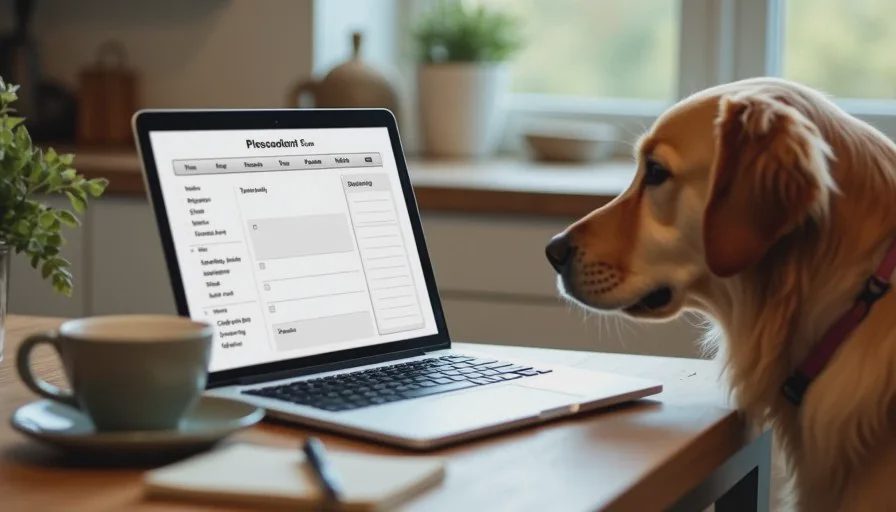
I’m Audrey Whitlock. I live in Denver with my husband Jake, our two kids, and a golden-retriever mix named Cooper who treats the living-room floor like his personal office. For years I led product operations at a B2B SaaS company. Now I help small teams reduce operational friction without adding more software. I also test tools the same way I test anything else: by asking whether they make an ordinary Tuesday easier or just create another thing to maintain.
This site is not about optimized mornings or polished routines. It is about building systems that remain useful when school pickup moves, a client changes priorities, or the dog needs an unexpected trip to the vet.
The Gap Between Advice and Real Life
A lot of productivity content looks clean. The screenshots are perfect. The routines start early. The tools never fail. The writer never seems to have a child who suddenly needs a ride or a meeting that runs long.
I used to try to follow those systems. Some of them worked for a week or two. Then Tuesday arrived. The carefully designed workflow collapsed under ordinary pressure. That pattern repeated enough times that I stopped chasing ideal setups. I started asking a different question: What still works when life is messy?
The answer turned out to be smaller and more human than most advice suggests. Systems that survive real conditions tend to be useful without being elaborate, flexible without being vague, and light enough that they do not become another job.
What “Surviving Tuesday” Actually Means
Tuesday is not a special day. It is the ordinary day that contains the interruptions, the context switches, the half-finished tasks, and the household logistics that never appear in the demo videos.
A system that only works on a quiet Monday morning is not a system. It is a performance. The ones I keep are the ones that bend without breaking when Noah needs help with a Minecraft server, Sophie has a last-minute gymnastics change, or Jake comes home and calmly points out that my latest automation has created more work than it removed.
His recurring line is simple: “If your system needs a system, it’s not a system.” He is usually right. That sentence has become a useful filter for everything I test.
How I Decide What Stays
I run every new tool or process through the same practical questions:
Does it reduce friction in real client work or household logistics?
Can it survive an interruption without requiring a full rebuild?
Is the setup cost worth the ongoing benefit?
Would I still use it if I were tired on a Wednesday afternoon?
I often test AI tools first on ordinary household problems. If something cannot help with a simple family calendar conflict or a shared to-do list, I stay cautious about handing it more important work. This habit keeps the advice here grounded in real conditions instead of ideal ones.
What You Will Find Here
The Workable Life is organized around four practical categories that reflect how I actually work and live.
Survive Tuesday
Personal essays about work systems under real pressure. Failed experiments, abandoned tools, and the ordinary days that reveal whether something is useful.
AI That Earns Its Keep
Honest tests of AI for writing, meetings, research, planning, and routine knowledge work. I show what I kept after the trial period and what I quietly stopped using.
The Friction Audit
Diagnostic pieces about where work gets stuck—email overload, unclear ownership, too many meetings, scattered documentation, tool sprawl. The goal is fewer moving parts, not more dashboards.
Systems at Home
How digital organization connects work, family logistics, school schedules, and household administration without turning the house into a control room.
You will also find notes from client work, family experiments, and the recurring reminder that a good system should still function when attention is limited.
Why the Name Matters
“The Workable Life” is deliberate. I am not interested in optimized lives or perfect routines. I am interested in systems that are useful enough, flexible enough, and human enough to keep going when the day does not go according to plan.
The standard I use for everything I publish is the same one I use at home and with clients: practical systems for work, family, and the days that don’t go to plan.
That phrase appears on the site for a reason. It is both a description and a filter.
A Note on Tone and Expectations
I write the way I talk after a long day—clear, a little tired, and unwilling to pretend that life is frictionless. You will see failed experiments. You will see tools I tried and later deleted. You will see the moments when a system that looked good on paper quietly made things worse.
I will not tell you that every problem needs a new app. I will not suggest that disorganization is a character flaw. I will not use fear language about AI or productivity. Most people are already doing the best they can with the attention and time they have.
My job is to share what has survived real use—both in client work and at home—and to be honest about the trade-offs. Some systems help. Some create more maintenance than they remove. The difference is worth noticing.

Getting Started
If you are new here, the Survive Tuesday essays show the filter I use for everything else. The AI experiments are useful if you are testing tools. The Friction Audit pieces help if your team keeps running into the same recurring problems. The Systems at Home posts are for anyone trying to keep work and family logistics from colliding.
You can also sign up for the newsletter. I send practical notes, not daily pressure.
Whatever you take from this site, I hope it helps you build something that still works on an ordinary Tuesday. That is the whole point.
Make it useful. Make it human. Make it survive Tuesday.




No comments yet — be the first to share a thought.