
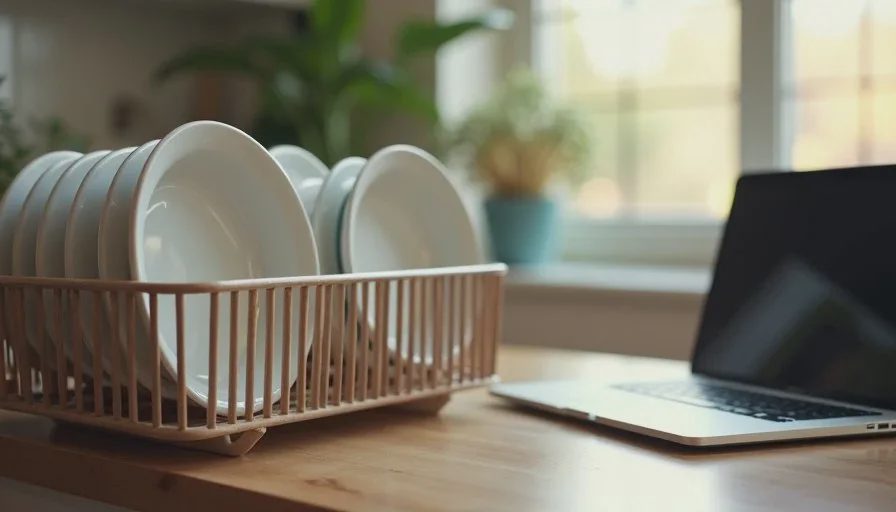
We were in the kitchen after dinner. I had just closed my laptop after finishing a note about an AI workflow. Sophie, eight years old and reliably precise, looked at the stack of clean dishes still sitting in the rack and asked why the AI I had been talking about could not put them away. Jake laughed. Noah offered that robots would do it eventually. I did not have a satisfying answer ready.
The question was fair. It also exposed a gap I spend a lot of time navigating: the difference between systems that organize information and the physical, repetitive, embodied work that still makes up a large part of ordinary family life. Digital tools and AI can help with calendars, lists, research, and writing. They do not clear the table, fold the laundry, or walk the dog. Pretending otherwise creates a quiet distortion in how we think about productivity at home.
I’m Audrey Whitlock. I live in Denver with Jake, Noah, Sophie, and Cooper. My work involves testing practical AI workflows and helping small teams reduce friction. At home the same standards apply, with one added reality: much of the work is physical and does not benefit from another app. Sophie’s question brought that boundary into focus more cleanly than most of my own analysis.
The Seduction of Digital Solutions for Everything
It is easy to slide into the habit of treating every friction as a candidate for a digital system or an AI assist. A recurring household task appears, and the mind reaches for a shared list, a reminder, a routine, or a smarter tool. Sometimes those additions help. Often they simply create a digital shadow of work that still has to be done with hands and time.
The dishes are a useful example because they are unambiguous. They are not a planning problem or an information problem. They are a physical task that reappears every day. No amount of optimized listing or AI scheduling removes the need for someone to put them away. The same is true for laundry, packing lunches, walking Cooper, and the dozens of other small physical acts that keep a household running.
When digital tools become the default response to every form of friction, we risk over-organizing the parts of life that are already clear and under-resourcing the parts that actually need human attention and labor. Sophie’s question was a reminder that the map is not the territory. A well-organized system about the work is not the same as the work itself.
What Digital Systems Actually Help With at Home
There are real places where light digital systems reduce household friction. The shared calendar that keeps school and activity logistics visible. The short current-week task list that prevents important items from living only in one person’s head. The simple reference note that holds the Wi-Fi password and the pediatrician’s number. These surfaces earn their place because they address information and coordination problems.
AI can assist in some of the same zones: turning a messy brain dump into a rough weekly outline, drafting a quick message, or summarizing a school newsletter. Used narrowly, these applications save small amounts of time and attention. They do not, however, cross into the physical layer. The boundary is worth keeping explicit.
When the boundary blurs, households can end up with elaborate digital infrastructure sitting on top of the same uncompleted physical tasks. The infrastructure creates a feeling of progress while the dishes remain in the rack. Sophie noticed the mismatch immediately.
The Limits That Are Easy to Forget
Several limits become clearer when viewed through a child’s straightforward question.
Physical work does not yield to better planning alone
Planning can sequence physical work and make sure it is not forgotten. It cannot perform the work. Any system that implies otherwise eventually collides with reality.
Attention is still required
Even the best shared list only helps if someone looks at it and then acts. Digital systems can support memory and coordination. They cannot supply the attention or the labor.
Automation has physical prerequisites
Robot vacuums and similar devices exist, and they help within narrow bounds. They still require setup, emptying, troubleshooting, and the acceptance of imperfect results. They do not eliminate household labor; they shift some of it. AI that lives on screens has even less direct reach into the physical environment of a home.
Children see the gap more cleanly
Adults often internalize the distinction between digital organization and physical work so thoroughly that we stop noticing when our tools over-promise. Children have not yet absorbed that separation. Their questions restore proportion.
These limits are not arguments against digital tools. They are arguments for using them only where they actually reduce friction and for keeping expectations calibrated.
How This Changed What I Emphasize at Home
Sophie’s question did not cause a dramatic overhaul. It reinforced a few existing preferences and made them more deliberate.
I am slower to add a digital layer to a purely physical recurring task. If the main problem is that the task is unpleasant or time-consuming, a list will not solve it. Sharing the labor or accepting a lower standard of completion often helps more than better tracking.
I try to keep the visible household systems short enough that they do not become a performance of organization. A short list that is acted on is more honest than a comprehensive system that primarily signals that someone is managing things.
I am more willing to say out loud, especially to the kids, that some work is just work. It does not need a clever system. It needs to be done, shared reasonably, and then set down until it reappears. There is less magic in that description and more accuracy.
Jake’s stance has always been closer to this baseline. He has little interest in elaborate household systems and prefers to handle the physical tasks that fall to him without additional digital overhead. The contrast is useful. It keeps me from over-indexing on the tools I happen to use for knowledge work.
What I Tell Sophie Now
When similar questions come up I try to answer them directly. AI can help with writing, research, scheduling, and organizing information. It cannot yet move dishes from the rack to the cupboard, and even when robots get better at specific physical tasks, the overall work of running a household will still require human attention, judgment, and labor. Some things remain ours to do.
This answer is less exciting than a vision of full automation. It is also more truthful about the near term and more respectful of the actual work that keeps a family day running. Sophie seems to find the distinction clarifying rather than disappointing. Children are often more comfortable with concrete limits than adults who have been sold expansive promises.
A Broader Standard for Household Systems
The dishes question supplies a useful test for any household system or tool: does this reduce real friction in the life we actually live, or does it mainly organize information about friction that remains unchanged? If the answer is the latter, the system is optional at best and a distraction at worst.
Useful household systems tend to be quiet, limited in scope, and tightly matched to genuine coordination problems. They do not try to digitize every aspect of family life. They leave the physical work visible as physical work instead of pretending it can be optimized into something else.
This standard is consistent with the rest of the approach on this site. Tools and AI workflows earn their place only when they make ordinary days lighter. When they cannot touch the actual constraint—as with the dishes—they should stay out of the way.
Will This Still Work on Tuesday?
Yes. On ordinary Tuesdays the dishes still need to be put away by a person. The shared calendar still helps with logistics. The short task list still catches the items that would otherwise create last-minute stress. AI still assists with certain kinds of writing and research. The boundaries between these domains remain clear.
Sophie’s question did not invent those boundaries. It simply made them harder to ignore. A fair question from an eight-year-old turned out to be a better audit of household systems than most of the frameworks I have used on purpose.
Make it useful. Make it human. Make it survive Tuesday.




No comments yet — be the first to share a thought.